

Using Claude for Long-Form Fiction: Character, Plot, and Continuity
Inside my novel project—and where I draw the line on AI assistance

A trilogy spanning multiple generations. Dozens of characters with distinct voices, arcs, and interweaving relationships. A timeline that stretches across decades. World-building rules that must remain consistent across 100,000+ words.
This is my novel project, which has consumed much of my creative energy over the past year.
And this is where AI assistance gets complicated.
Newsletter cleanup is straightforward: I dictate, Claude polishes, and I review. Tutorial production is systematic; there’s a template, a checklist, and a clear process. But fiction? Fiction is different.
Fiction is the most personal creative work I do. The characters live in my head. The story emerged from my imagination. The prose carries my voice in a way that matters far more than in any newsletter or tutorial. If AI assistance flattens that, if it makes my novel sound like anyone could have written it, then I’ve failed at the most fundamental level.
So how do I use Claude for fiction without losing what makes the work mine?
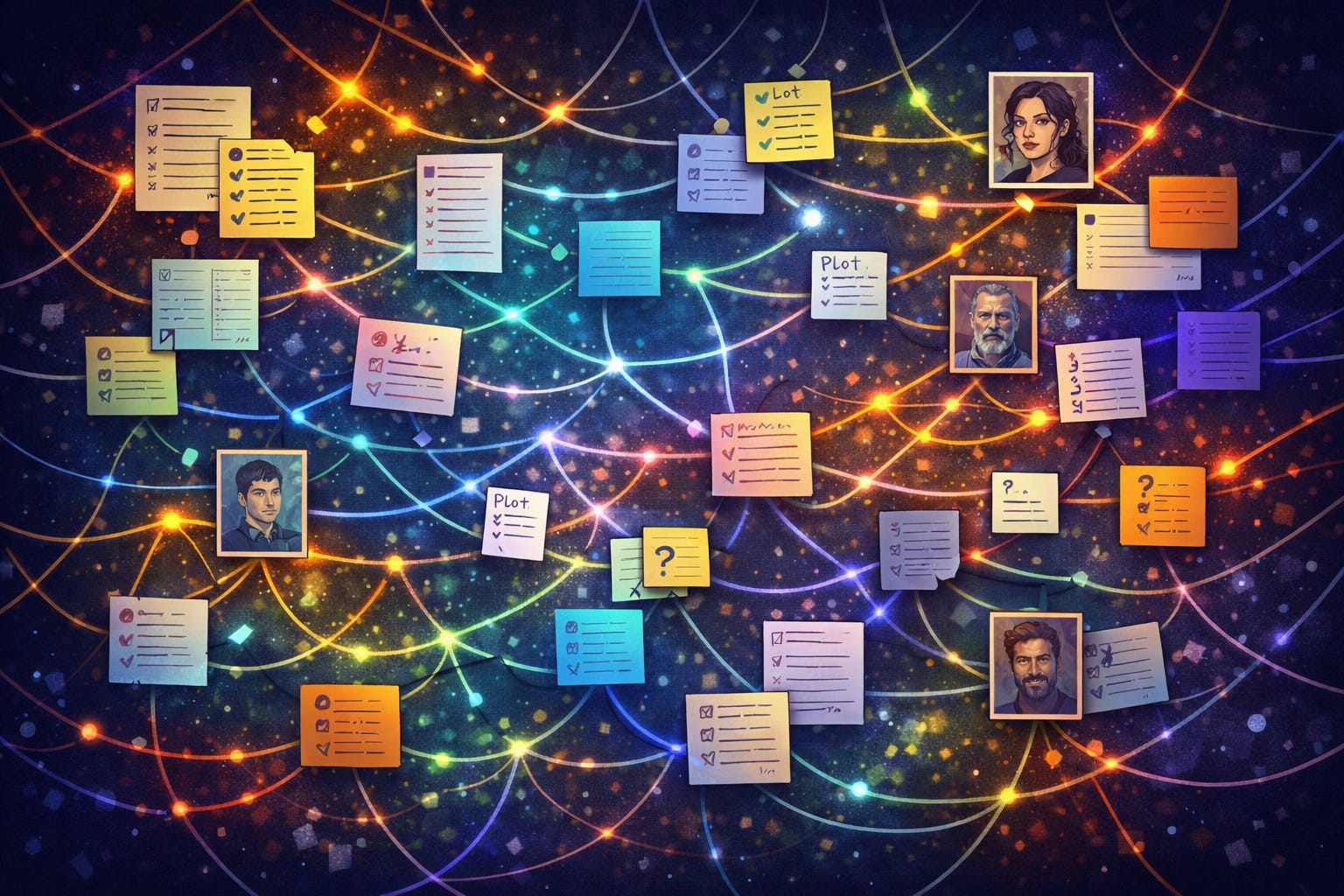
Why Fiction Is Different
A newsletter has to sound like me, but if one paragraph feels slightly off, it’s not a disaster. I’ll catch it in editing, or readers will forgive it because the ideas are solid.
A novel is different. Voice consistency matters across 300 pages, not 1,500 words. Characters must speak and behave consistently from chapter to chapter and month to month throughout the writing. Plot threads planted in chapter 3 need to pay off in chapter 40. World-building established early must hold throughout.
The opportunities for continuity errors are enormous. Did I establish that character as left-handed in chapter 12? Does the timeline actually work if the protagonist was four years old during the massacre and forty-four in the present narrative? Have I accidentally contradicted a world-building rule I set up 50,000 words ago?
Human memory is fallible. Over months of writing, details slip. And in a novel, readers notice inconsistencies. They break the spell.
This is where AI assistance becomes genuinely valuable, not for writing, but for tracking.
The Project Setup
My fiction project is the most extensively configured of my three Claude projects. Let’s walk you through what it contains.
Story Overview
The instructions begin with essential context:
Genre: Science Fiction / Dystopian Political Thriller
Target Audience: Adult readers who enjoy complex world-building and multi-generational narratives
Tone: Dark and socially conscious, with moments of human warmth and hope; politically charged but character-driven
Point of View: Third person limited, switching between key characters across different time periods
Tense: Past tense
This establishes the foundation. Every suggestion Claude makes should align with these parameters. A suggestion that would fit a light romance or a first-person narrative gets filtered out before it reaches me.
Core Themes
The instructions explicitly list the themes I’m exploring:
Corporate tyranny vs. individual freedom
Cycles of resistance across generations
Identity and legacy
The cost of revolution
Hope in darkness
These aren’t just notes for me; they guide Claude’s suggestions. When I’m stuck on a scene, Claude’s brainstorming pulls toward these themes rather than wandering into territory that doesn’t serve the story.
Character Documentation
This is the largest section. For each major character, the instructions include:
Arc: Where they start, how they change, where they end up
Voice: How they speak, their education level, verbal tics
Key traits: Personality, values, contradictions
Relationships: Connections to other characters
Speaking style: Specific notes like “uses Dutch phrases when emotional” or “military precision mixed with moral conflict.”
Current status: Where they are in the story as of the latest draft
Here’s a condensed example for one character:
Arc: Humble community man → resistance martyr (faked death) → engineer → commander
Voice: Working-class, practical, deeply moral; introverted but determined
Key traits: Strong sense of duty, loves his wife and son deeply, carries guilt about leaving them
Speaking style: Simple, direct, occasionally uses Dutch phrases when emotional
This level of detail means Claude can flag when I’ve written dialogue that doesn’t match a character’s established voice. It can remind me of relationship dynamics I might have forgotten. It can catch when a character’s behavior contradicts their established psychology.
World-Building Rules
The instructions include the constraints of my fictional world:
How the corporate power structure works
What technology exists (and what doesn’t)
Environmental conditions
Social hierarchy and class system
What’s public knowledge vs. what’s secret
When I write a scene that accidentally violates these rules, Claude can flag it. When I brainstorm plot developments, suggestions stay within established parameters.
Timeline Tracking
The instructions contain the critical dates and time relationships. This is reference material Claude can check against when I write scenes. “Wait, if a character were a certain age during the inciting incident, he’d be so many years now, but I had written something else entirely, that kind of catch.
Writing Style Preferences
Beyond the story elements, the instructions include explicit guidance on style:
Do:
Show internal character struggle
Use sensory details for atmosphere
Ground political commentary in personal stakes
Let silence and body language speak
Plant details for later payoff
Create authentic, complicated relationships
Avoid:
Info-dumping
Melodrama
Simplistic villains
Convenient coincidences
Head-hopping within scenes
Excessive exposition
This shapes how Claude responds when I ask for help with a scene. Suggestions lean toward showing rather than telling, toward earned emotional moments rather than melodrama, toward complexity rather than convenience.
Two Key Tools: Reformat and Restructure
I use two distinct trigger keywords for different types of assistance.
”Reformat” — Cleaning Up Dictated Scenes
Like my newsletter workflow, I often dictate fiction scenes while walking. The raw transcription needs cleanup: dialogue formatting, punctuation, and removal of verbal tics.
The “Reformat:” keyword tells Claude to:
Format dialogue properly (double quotes, new paragraph for each speaker)
Fix punctuation and grammar
Remove transcription artifacts
Preserve the original narrative voice exactly
That last point is critical. For fiction, I want even less intervention than for newsletter content. Claude cleans up mechanics but doesn’t touch my prose style, my word choices, my rhythm. If a sentence is awkward, Claude flags it rather than fixing it. The creative decisions remain mine.
”Restructure” — Improving Pacing and Beats
Sometimes a scene has all the right content but poor pacing. Actions, dialogue, and internal thoughts are jumbled together. Emotional beats get buried in dense paragraphs. The scene works, but it doesn’t breathe.
The “Restructure:” keyword triggers a different process:
Core Principles:
Separate actions, dialogue, and thoughts clearly
Break dense paragraphs into natural emotional beats
Isolate key moments that deserve emphasis
Create rhythm through alternating action, reflection, dialogue
Preserve ALL original content—formatting only, not rewriting
This is purely structural work. Claude reorganizes existing content for better flow but doesn’t add, remove, or change anything. My words, better arranged, but only if I agree to any changes.
I mostly don’t, but I often learn something new about the craft.
The Ethical Line for Fiction
Here’s where I draw an absolute boundary: Claude never writes my prose.
I’ve experimented with asking Claude to expand scenes. It produces competent output, 1,500 words that hit the right beats, include sensory details, and follow the style guidelines. Technically proficient. Sometimes, it is even impressive.
But it’s not mine.
When I read AI-generated prose, even when it’s based on my characters and story, something’s missing. The unexpected word choice that comes from my particular brain. The rhythm that emerges from my particular voice. The small decisions that accumulate into style.
So I use Claude-generated expansions differently. I’ll read through 1,500 words of AI output and find maybe 3–5 ideas worth keeping. A detail I hadn’t considered. An emotional beat I’d overlooked. A line of dialogue that sparks a better line of my own.
Then I close the AI output and write the scene myself, incorporating those sparks but translating everything into my voice.
This is the test I apply: Could I explain and defend every sentence? If I couldn’t tell you why I made a particular word choice, because I didn’t make it, Claude did, then it doesn’t belong in my book.
What Claude Does Well for Fiction
Within these boundaries, Claude provides genuine value:
Brainstorming: When I’m stuck on a scene, I’ll describe the situation and ask for five different approaches. Claude generates options. Most don’t work, but one might unlock something.
Consistency checking: “Given what we know about this character, would they really react this way?” Claude can flag behavior that contradicts established psychology.
Timeline verification: “Does this scene’s timeline work with what I established in chapter 12?” Claude catches errors I’d miss.
Plot hole identification: When I upload new chapters, Claude can identify gaps, contradictions, or dropped threads.
Character voice comparison: “Does this dialogue sound like Jan or more like Charlie?” Claude can compare against established voice patterns.
World-building consistency: “Does this technology exist in my world?” Claude checks against established rules.
What Claude Can’t Do
Just as importantly, here’s what AI cannot do for fiction:
Generate authentic emotional moments. The scenes that make readers cry or cheer come from human experience translated into prose. AI can approximate the structure of emotional moments but not their soul.
Write in my voice. Even with extensive reference material, Claude produces a simulation of my style, not the real thing. Close enough to be useful for brainstorming. Not close enough to publish.
Make creative decisions. Where should the story go? What does this character really want? How should this scene end? Those decisions define the book. They can’t be outsourced.
Replace the hours of actual writing. There’s no shortcut to sitting with the manuscript and doing the work. AI can make some parts of that work more efficient, but the work itself remains.
Lessons Learned
Building and refining this project over the last six months has taught me several things:
Comprehensive instructions take time but pay off. Every hour spent documenting characters, timeline, and world-building saves multiple hours catching errors later.
Living documentation matters. The instructions aren’t static. As the story evolves, I update character arcs, add new plot threads, and refine world-building rules. The project grows with the manuscript.
The “Do/Avoid” framework keeps suggestions useful. When Claude knows to avoid info-dumping and melodrama, its suggestions stay in usable territory.
Boundaries must be explicit. “Never write prose for me” is in the instructions, in bold. Without that explicit boundary, Claude will helpfully offer to draft scenes. With it, Claude stays in assistant mode.
Try It Yourself: Fiction Project Starter Template
If you’re working on long-form fiction and want to experiment with AI assistance, here’s a framework:
STORY OVERVIEW:
Genre:
Tone:
POV and Tense:
Core Themes:
MAIN CHARACTERS: For each: Name, arc, voice, key traits, relationships, speaking style, current status
SUPPORTING CHARACTERS: Brief descriptions of role and key details
WORLD-BUILDING RULES: Key constraints, technology, social structure, etc.
TIMELINE: Critical dates and time relationships
WRITING STYLE:
Do: Your preferences
Avoid: Your anti-preferences
KEYWORDS:
“Reformat” — Clean up dictated scenes, preserve voice exactly
“Restructure“ — Improve pacing, no content changes
“Brainstorm“ — Generate options for a specific element
ABSOLUTE BOUNDARY:
Never write prose for me. Suggest, flag, brainstorm, but the writing is mine.
Final Thoughts
Fiction demands the most careful boundaries around AI assistance. The stakes are highest, and the temptation to let AI do too much is strongest.
What I’ve found is that AI is genuinely useful for fiction, just not in the ways most people assume. It’s not a writing tool. It’s a tracking tool, a brainstorming tool, a consistency tool. It handles the mechanical challenges of managing a complex project so I can focus on the creative challenges of telling a good story.
My novel is mine. The characters emerged from my imagination. The prose carries my voice. The creative decisions, every single one, come from me.
Claude helps. But Claude doesn’t write. That’s the line. And I won’t cross it.
Next: The final article in this series—how to build your own Claude project from scratch, with templates and a checklist you can adapt.